
Regional Australians trust their neighbours more than city residents do, but trust their institutions less. New research from the Regional Australia Institute maps that gap and sets out what it would take to protect the local bonds that hold regions together.
On three measures of faith in the system – democracy, the Federal Government and public services – people in outer regional and remote Australia sit about 12 percentage points below those in major cities. Yet regional Australians volunteer more, have stronger neighbourhood bonds and are more likely to trust one another.
Those findings anchor the Regional Australia Institute’s (RAI) latest Regional Impact Essay: Social Cohesion and Community Sentiment in Regional Australia, released on 4 November 2026. The RAI argues that strong local ties are helping regions withstand economic and social pressure, but can wear thin without long-term investment in the services, places and local leadership that hold communities together.
RAI CEO Liz Ritchie said regional communities had a remarkable capacity to come together and support one another.
“But these strengths cannot be taken for granted. When people are under financial pressure, cannot access essential services or feel their community is being left behind, trust and belonging can quickly begin to erode.”
At a glance
- People in outer regional and remote areas are about 12 percentage points less satisfied with democracy and public services than people in major cities.
- Regional Australians volunteer more and report stronger neighbourhood bonds and interpersonal trust.
- The RAI says structural pressures such as financial strain and limited access to services may affect cohesion more than diversity itself.
- It calls for better local data, social infrastructure open to all, a stronger role for employers and support for local leadership.
Close to neighbours, further from institutions
McKinnon Index 2026 data cited by the RAI shows outer regional and remote residents trailing major cities on all three measures below.
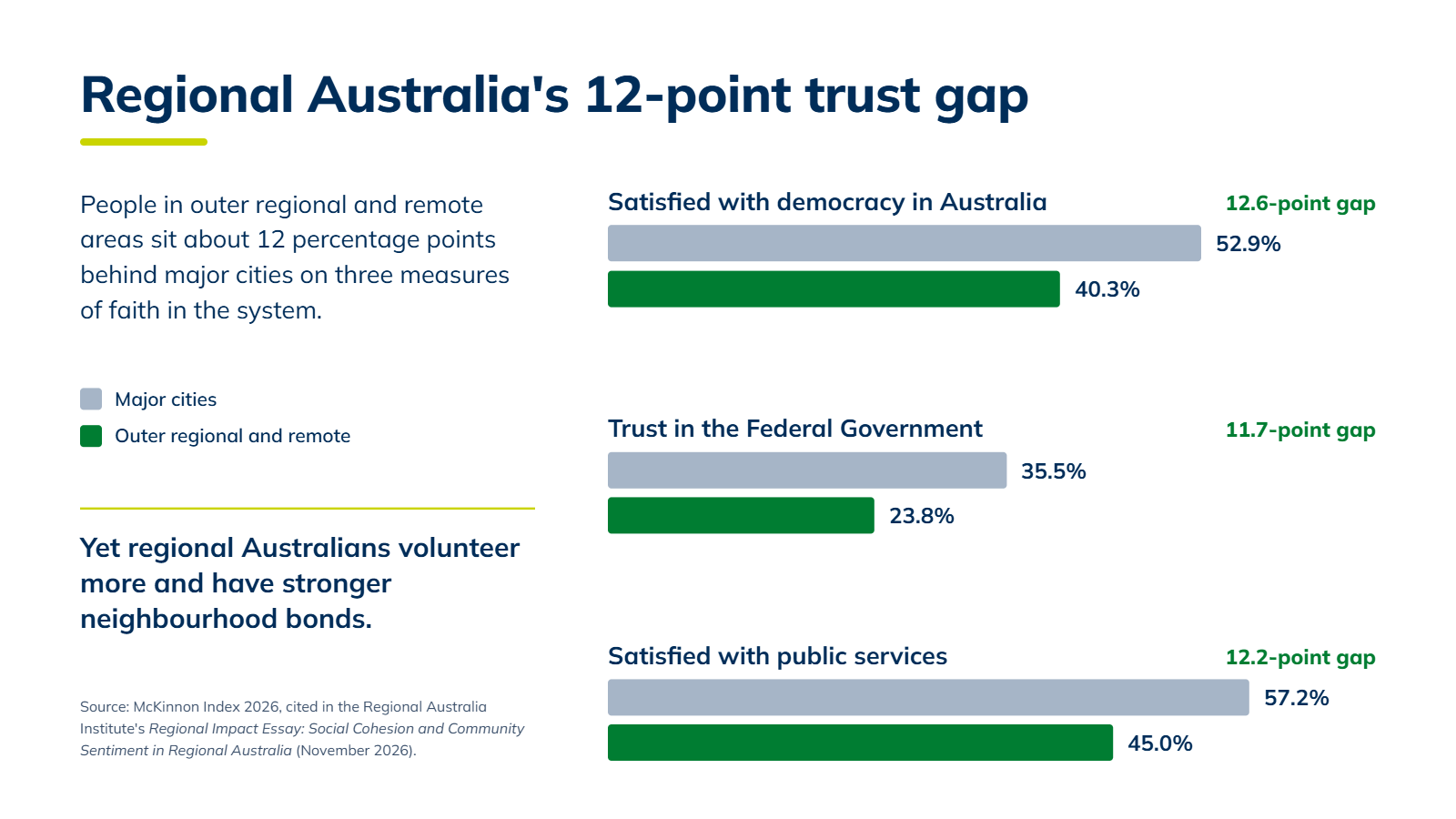
Inner regional areas sit between the two, with 50.2% satisfied with public services. Australian Public Service Commission data points the same way: trust in public services is 56% in regional areas compared with 65% in metropolitan areas, a gap the RAI links closely to access to services.
The picture of local life is different. ABS General Social Survey data shows regional Australians are more likely to volunteer and take part in community support groups. The RAI concludes that while cities offer more opportunities for social contact, interpersonal trust and neighbourhood bonds are stronger outside them – quality of connection rather than quantity.
There are pressure points too. A 2023 national survey found 46% of Australians were at risk of social isolation, rising to 49% in regional and remote areas.
More than a migration story
Public debate often treats social cohesion as shorthand for migration and diversity. The RAI argues for a broader definition.
“Social cohesion isn’t simply about migration or diversity. It is about whether people feel connected to those around them, included in community life and able to participate in decisions that affect their future,” Ms Ritchie said.
The RAI finds cost of living and housing affordability are strongly linked to declining trust. It suggests financial stress, unemployment and the shift from in-person to online interaction may matter as much as, or more than, population change.
Because migrants are highly visible, they can become a proxy for those harder-to-pin-down concerns. Scanlon Foundation data shows how tangled they are: 78% of people who think immigration is too high also believe migrants increase housing costs.
Migration can strengthen regional communities by filling workforce gaps and sustaining local businesses. Refugees have helped revitalise towns from Nhill to Orange, and resettlement in places such as Leeton is considered a social and economic success. Refugees in regional areas also have a higher share of mixed social contacts (67%) than those in major cities (48%).
Those benefits are not automatic. The RAI notes Australia’s settlement support is focused largely on refugee and humanitarian arrivals, with patchier help for other newcomers, and local councils often fill the gap despite having little formal responsibility. Change perceived as too fast, or made without consultation, can also sour local sentiment.
A patchwork of programs
The RAI finds that support for social cohesion is spread across many programs and levels of government. In its assessment, much multicultural funding supports specific migrant and ethnic groups, other grants focus on preventing harm, and broad local priorities such as libraries and neighbourhood centres receive less.
Several Commonwealth programs that already support community connection, including in the regions:
- Strong and Resilient Communities (Department of Social Services) – $63 million over six years to 2028, with 45% of projects in regional and remote Australia.
- Stronger Communities Program – $22.5 million over two years from 2026–27 for Round 10, offering small grants to community organisations and councils.
- Growing Regions – $600 million between 2023 and 2028 for larger infrastructure, including community centre refurbishments.
The second issue the RAI raises is capacity. Some towns appear repeatedly on grant lists while others never surface, and short-term funding takes staff time that some regional councils do not have.
“Regional communities know what they need, but too often they don’t have the time or resources to navigate short-term, complex funding programs. We need to make it easier for stretched Councils to secure the investment their communities deserve,” Ms Ritchie said.
The RAI points to the National Community Hubs Program as a model that works with existing infrastructure. Its 100 school-based hubs are open to the whole community, and a 2023 evaluation estimated a social return of around $3.50 for every dollar invested.
What the RAI is calling for
The RAI wants a more coordinated, place-based approach to social cohesion. Its four recommendations are aimed at policymakers at all levels of government:
- Better regional data. Disaggregated, longitudinal data would reveal differences between communities that national averages mask, and could act as an early warning system before pressures build.
- Social infrastructure for everyone. Libraries, schools, sporting clubs, neighbourhood centres and halls should be multipurpose and open to all, with the RAI suggesting a local social infrastructure “report card”.
- A stronger role for employers. Workplaces are a key source of connection for newcomers, and governments should engage employers more actively in settlement and community life.
- Local leadership and communication. Governments could build the capacity of regions to tell inclusive local stories, drawing on what has worked in Australia and overseas.
The RAI is also calling for increased investment in settlement support services for regional communities.
What it looks like on the ground
Two examples the RAI highlights show regional communities, employers and local RDAs already doing what it recommends.
- The Murray. Employers along the Murray River have worked with communities to attract migrants from Western Sydney, including through Newcomer Attraction and Retention plans.
- Riverina. The RAI cites RDA Riverina’s Skilled Migration Success Stories as an example of local storytelling that grounds the migration conversation in local experience rather than national narratives.
The RAI argues that the role employers play in welcoming newcomers remains under-recognised in policy. Ms Ritchie said governments at every level had a role in recognising and supporting regional employers who help migrants settle and become part of their communities.
Why it matters for RDA Sydney
The findings speak to two of RDA Sydney’s four themes. On workforce, RAI notes that retaining newcomers matters as much as attracting them, and the Murray example links regional jobs with Sydney’s population. On housing, it ties affordability pressures closely to declining trust.
That idea of a proper welcome is already at work in regional NSW. The Welcome Experience, a NSW Government program, pairs essential workers and their families who are moving to the regions with a Local Connector, who provides advice, introductions and support throughout the move.
Across the regional NSW, select RDAs host the program. Since its 2023 pilot, it has supported more than 3,000 essential workers and their families, and in April 2026 the NSW Government announced its expansion from 55 to 88 local government areas.
RAI’s call for better local data also makes the case for local intelligence. National averages can hide what is happening in individual towns, and regional RDAs see those differences first-hand.
An asset worth protecting
The RAI’s conclusion is simple: social cohesion is an asset worth safeguarding, as important as public service provision, and regional Australia.
“Social cohesion is critical for every region and protecting it requires long-term investment in the places, relationships and local leadership that bring communities together.
“Because once it’s lost, it’s hard to regain,” Ms Ritchie said.
Read the full essay: Regional Impact Essay: Social Cohesion and Community Sentiment in Regional Australia. The RAI acknowledges the contribution of Elizabeth Collett, Global Fellow at the Migration Policy Institute.
The Regional Impact Essay was funded by the Australian Government through the Department of Infrastructure, Transport, Regional Development, Communications, Sport and the Arts.