

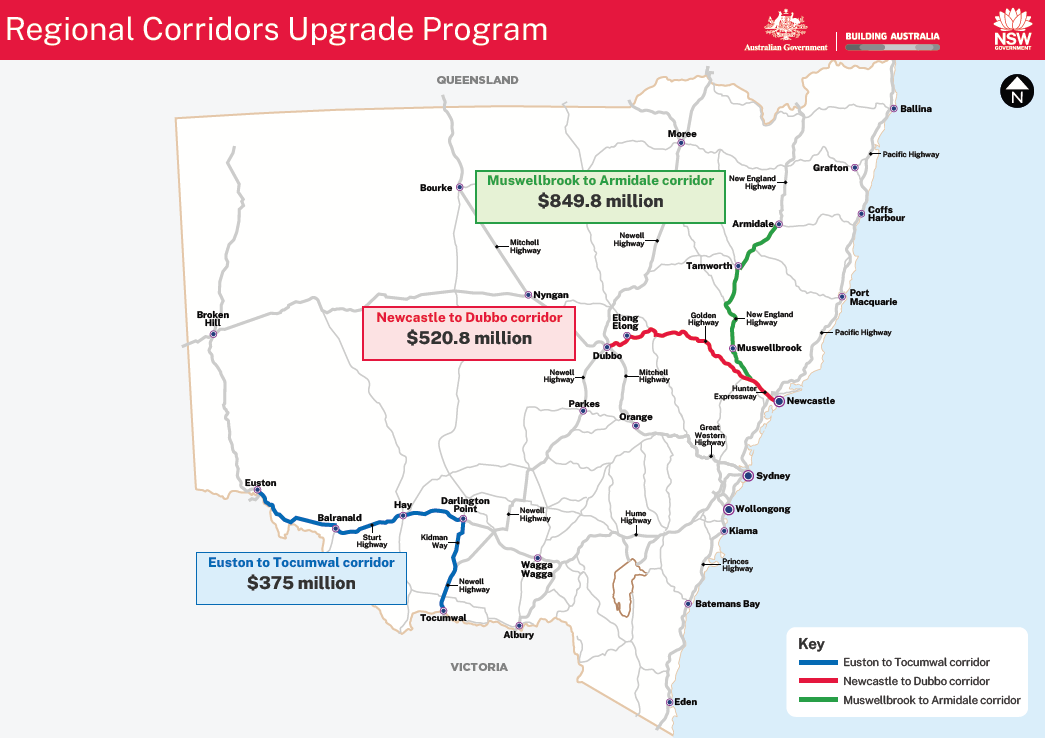
Three major road corridors linking the Hunter, Central West, New England, Riverina and Murray are set for more than $1.74 billion in upgrades, targeting the roads that carry regional NSW’s people, produce and freight.
For regional NSW, a road is rarely just a road.
It’s how produce gets from farm gate to market, how businesses reach customers and ports, how workers get to jobs and how families travel between towns and services.
Now three of the state’s most important regional corridors are set for a major overhaul, with the Australian and NSW governments committing more than $1.74 billion to improve safety, freight efficiency and connectivity.
Under the new Regional Corridors Upgrade Program, the Australian Government will contribute $697 million and the NSW Government $1.049 billion.
The investment includes $520.8 million for the Newcastle–Dubbo corridor, incorporating the Golden Highway, John Renshaw Drive and Hunter Expressway; $849.8 million for the Muswellbrook–Armidale corridor, including key sections of the New England Highway; and $375 million for the Euston–Tocumwal corridor, including the Sturt and Newell highways and Kidman Way.
Across the three corridors, work will include wider roads, shoulders and intersections, turning and overtaking lanes, digital traffic signs and monitoring cameras.
New and upgraded rest stops, pull-over bays and heavy-vehicle facilities are also planned, with more than 1,000 jobs expected to be supported across NSW.
Golden Highway: the case for investment has already been building
For RDA Orana and RDA Hunter, the Newcastle–Dubbo announcement comes after sustained work to put the Golden Highway’s growing freight task on the government agenda.
The two RDAs established the Golden Highway Taskforce in March, bringing together industry, government and regional leaders to advocate for coordinated investment in the Dubbo–Newcastle transport corridor.
Analysis underpinning that work forecasts freight volumes along the Golden Highway corridor increasing from about 2.5 million tonnes to around 6.3 million tonnes over the next decade, driven by agriculture, mining, containerised freight, renewable energy and critical-minerals development.
RDA Orana CEO Justine Campbell and RDA Hunter CEO Kate O’Mara:
“We welcome the Minister’s announcement and the commitment to improving the Golden Highway. RDAs Orana and Hunter have advocated for several years for investment in this important freight corridor to ensure it is fit for the growing freight and economic activity it supports.
“We look forward to seeing further details of the investment and the specific projects it will be deliver.”
RDA Hunter and RDA Orana have already developed road and rail business cases for the corridor, with their Golden Highway work identifying overtaking opportunities, bridge and intersection improvements and other targeted safety measures among the priorities.
A major investment through New England
The largest allocation – $849.8 million – will go to the Muswellbrook–Armidale corridor, including upgrades to key sections of the New England Highway.
For the Northern Inland, the highway is both a major freight route and an essential passenger connection through a region where distance shapes access to jobs, businesses and services.
RDA Northern Inland has long identified safe and efficient road, rail and air links as fundamental to economic growth, with improved freight movement and stronger transport infrastructure among its strategic priorities.
From Euston to Tocumwal
In the state’s south-west, $375 million will be directed to the Euston–Tocumwal corridor, including sections of the Sturt and Newell highways and Kidman Way.
It is an investment with significance across both the Murray and Riverina.
Euston and Tocumwal sit within the RDA Murray region, while the wider corridor passes through the agricultural and freight-intensive landscapes of the Riverina, including areas around Hay and Carrathool.
For industries built around agriculture, food production, manufacturing and logistics, the efficiency of those connections can flow directly into the cost and reliability of moving goods.
RDA Murray CEO Sarimah Hellyer:
“The Murray region is a critical part of Australia’s agricultural and freight network, and the reliability of our road infrastructure directly impacts the competitiveness of our industries and the safety of our communities. With the scale of investment anticipated through the South West Renewable Energy Zone, we’re going to see increasing pressure on roads already carrying significant agricultural and commercial freight.
“This investment is very welcome, but it’s important that upgrades are planned with the region’s long-term needs in mind. We have an opportunity to ensure infrastructure built to support major projects also delivers lasting improvements in road safety, freight efficiency and economic productivity for our communities and businesses.”
RDA Riverina CEO Rachel Whiting:
“RDA Riverina welcomes this investment in our road network and the benefits it will deliver to regional communities, businesses and freight operators.
“We would also encourage ongoing investment to close the remaining gaps along the Newell Highway between Dubbo and Tocumwal, creating a more efficient, resilient and nationally significant freight corridor for inland Australia.”
Roads facing a bigger job
There is another reason these corridors are attracting investment.
The 2026–27 NSW Budget explicitly identifies regional corridor upgrades as part of the infrastructure required to support the state’s renewable energy build-out.
It links Newcastle–Dubbo upgrades with the Central-West Orana Renewable Energy Zone, Muswellbrook–Armidale with the New England REZ and Euston–Tocumwal with the South West REZ, including the need to move oversize renewable-energy components along regional roads.
But that freight task will sit alongside everything these roads already carry.
Agricultural produce, livestock, mining and manufacturing freight will share the network with commuters, families, tourists and the vehicles supplying regional towns.
That makes road capacity a regional economic issue, but also an everyday safety issue.
Federal Infrastructure, Transport, Regional Development and Local Government Minister Catherine King said the investment would support regional productivity and supply-chain resilience.
“Our export industries and freight operators are the backbone of the Australian economy, and they rely on safe and reliable roads.”
NSW Roads Minister Jenny Aitchison said the program would go well beyond minor works.
“These will not be minor upgrades. We’re building safer intersections, wider roads and shoulders, overtaking lanes, better rest areas, and heavy vehicle facilities.”
Work already under way
Some of the first changes are already visible.
New line marking and traffic-management signage is being delivered at town entry points along the Golden Highway at Dubbo, Dunedoo, Jerrys Plains, Denman and Sandy Hollow.
The wider program is also being accelerated through the NSW Government’s Project Swift initiative, which is designed to reduce duplication and allow planning, design, procurement and other project stages to proceed concurrently where appropriate.
It follows the opening last month of the 15-kilometre M1 Pacific Motorway extension between Black Hill and Raymond Terrace, delivered about 18 months ahead of its original timetable.
For the communities and industries relying on the next round of upgrades, however, the measure of success will ultimately be much more prosaic: safer overtaking, fewer bottlenecks, better places for truck drivers to stop and more predictable journeys between regional centres.
More than $1.74 billion is a substantial investment.
The bigger test will be whether it leaves regional NSW with road corridors capable of carrying what comes next.


