
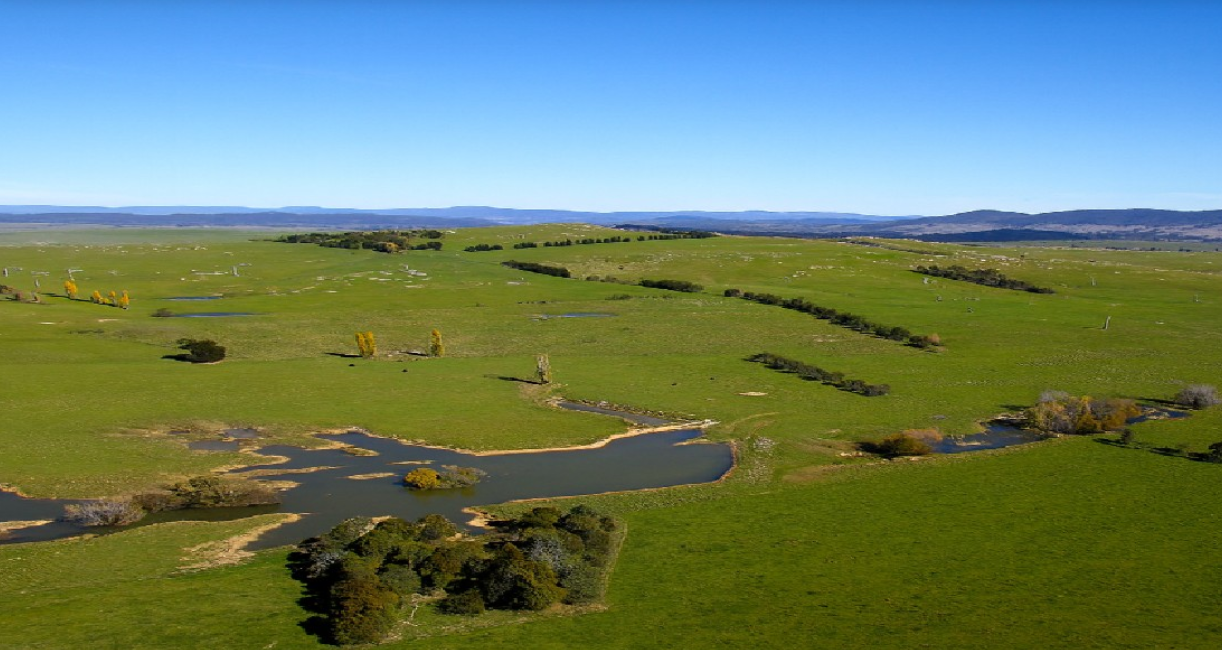
From exploding balloons to restoring degraded waterways, a Central Coast workshop has challenged conventional thinking about how we manage water on the land, and what that could mean for the future of farming in regional NSW.
It took just 2.8 seconds for the first balloon to burst.
Held against a flame, the air-filled balloon offered little resistance to the heat. But when Erin Healy from the Mulloon Institute repeated the experiment with a second balloon containing a tablespoon of water, something remarkable happened.
The seconds ticked by. Ten. Twenty. Thirty. The balloon remained intact.
It was an unconventional start to a landscape rehydration workshop at the Central Coast Wetlands Pioneer Dairy in Tuggerah on Wednesday 11 November, but the message was clear: water does far more than keep plants alive. It helps regulate temperature, maintain healthy soils and protect landscapes against climatic extremes.
The demonstration was part of a hands-on workshop delivered by Greater Sydney Local Land Services, bringing together farmers and landholders to explore how restoring natural water cycles can improve soil health, reduce erosion, support biodiversity and strengthen agricultural productivity.
Led by Ms Healy and regenerative farmer Martin Royds of Jillamatong, near Braidwood, the day combined scientific explanations with practical demonstrations of how water moves through landscapes, why degraded waterways lose their ability to retain moisture and what landholders can do to restore that function.
At its heart was a deceptively simple proposition: rather than focusing solely on capturing water in dams and other storage systems, what if we could help the landscape hold onto more of the rain that falls?
For farmers facing increasingly variable conditions, the answer could have far-reaching implications.
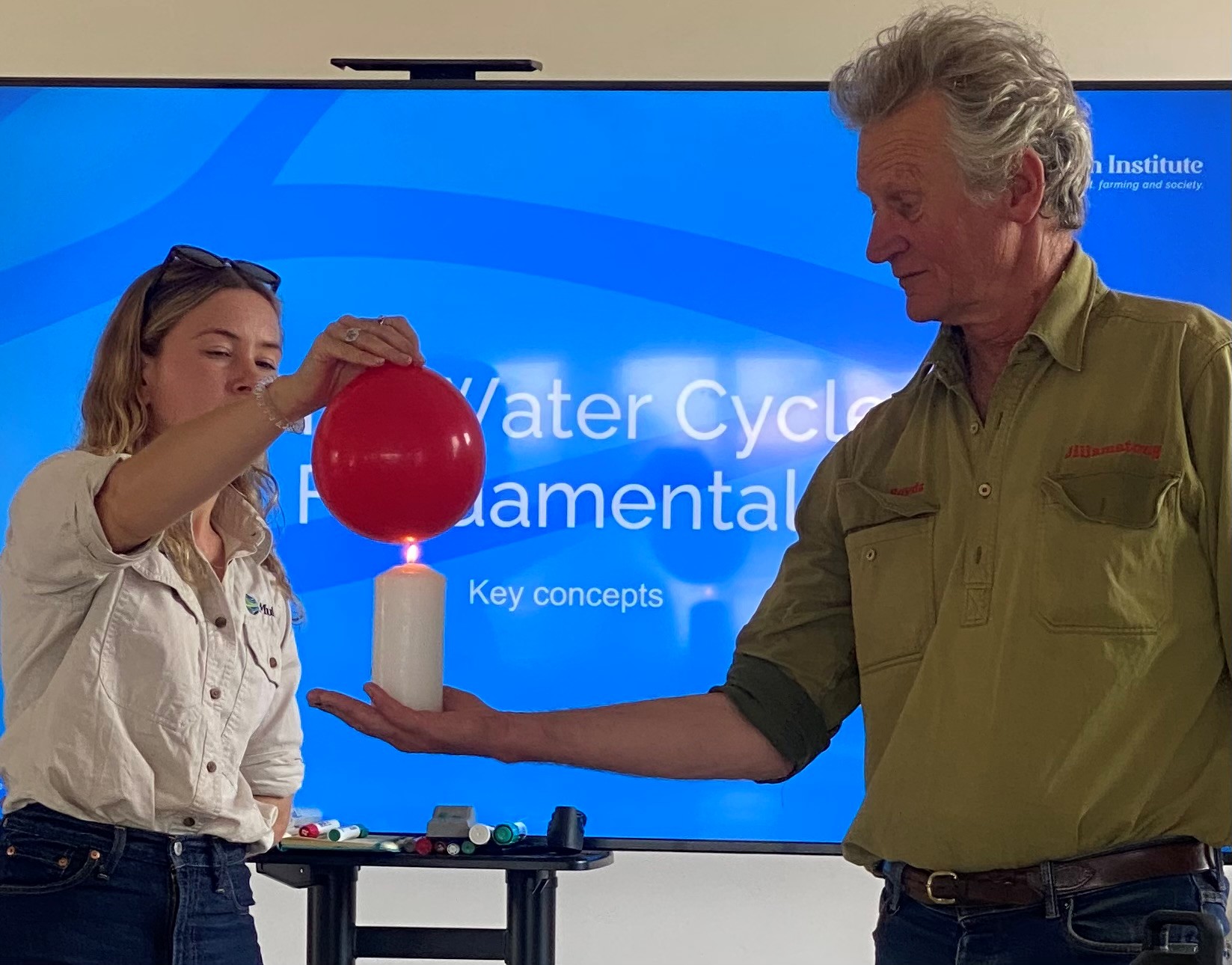
Mulloon Institute’s Erin Healy and Jillamatong’s Martin Royds explore the roll of water. Image: Liz Ginis
When the landscape becomes a drain
For generations, agricultural development across Australia has involved clearing vegetation, draining wetlands and straightening waterways to make land more productive.
But those changes have sometimes had unintended consequences.
Ms Healy explained how creeks and gullies that once allowed water to spread slowly across floodplains have become deeply incised channels, carrying water, sediment and valuable nutrients rapidly downstream.
As erosion deepens, it can also lower surrounding groundwater levels, leaving once-moist soils dry and brittle.
She likened the process to pulling the plug from a bathtub.
“Sometimes it’s more effective to think about it as landscape dehydration,” she told the workshop.
The challenge, she explained, is not simply how much rain falls. It is what happens when that rain reaches the ground.
Healthy soils, rich in organic matter, roots and biological activity, allow water to infiltrate and remain available to plants. Compacted or exposed soils are more likely to shed water as runoff, increasing the risk of erosion.
“Having more water in the landscape isn’t always necessarily about the amount of rainfall you get. It’s about the soil structure,” Ms Healy said.
That distinction is particularly important as farmers contend with periods of intense rainfall interspersed with prolonged dry conditions.
A heavy downpour offers limited benefit if most of the water leaves the property before it can soak into the ground.
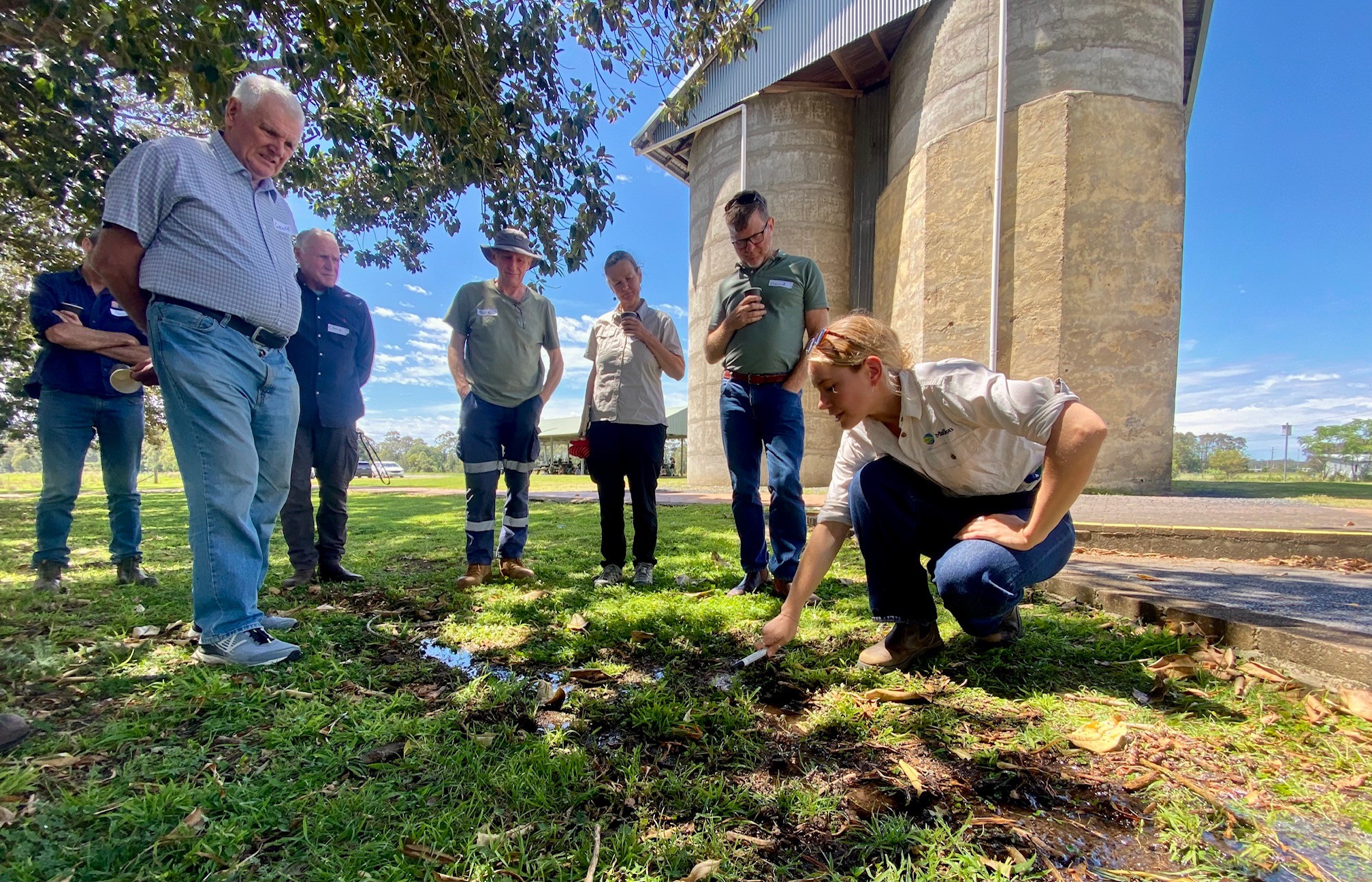
Erin Healy demonstrates water flow practices at Central Coast Wetlands. Image credit: Liz Ginis
A four-metre gully and a different way of farming
For Mr Royds, the consequences of landscape degradation are more than theoretical.
At Jillamatong, his property near Braidwood in the NSW Southern Tablelands, a landscape once characterised by boggy meadows and chains of ponds had been progressively drained and eroded, leaving a gully more than four metres deep.
The original intention was to make wet country more suitable for grazing and cropping.
Instead, the drainage system accelerated erosion and disrupted the natural movement and storage of water.
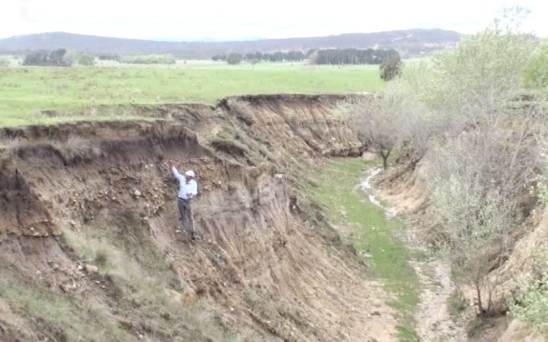
An erosion channel. Image: Courtesy Jillamatong
Mr Royds began experimenting with ways to slow the flow, eventually drawing on the natural sequence farming principles developed by Peter Andrews, whom he met in 2005.
He installed a series of weirs and other structures designed to slow water, encourage sediment deposition and help restore moisture across the surrounding landscape.
Combined with vegetation management, the interventions have helped rebuild the former waterway and change how water behaves across the property.
Mr Royds showed photographs and video comparing runoff from neighbouring land with conditions on his own farm.
Where water rushed across exposed ground carrying sediment, vegetation and restored wet areas at Jillamatong helped slow and filter the flow.
The difference was apparent in the water itself.
“This is the same day, the water was running clear,” he said.
The restoration has also made a practical difference to how Mr Royds manages his farm.
Previously, heavy rainfall sent water rushing through the eroded channel, damaging fences.
“Every time it used to rain on my place … I had to go and fix the fences for two kilometres,” he recalled.
Now, restored vegetation and a series of weirs help slow and spread the water, reducing its destructive force. The weirs also provide crossings between parts of the property once separated by the 4m-deep gully.
Importantly, Mr Royds can also manage water levels within parts of the system, allowing him to retain moisture without permanently waterlogging productive ground.
His experience offers a striking example of how repairing degraded landscapes can deliver both environmental and practical farming benefits.
The most valuable infrastructure might be a plant
While the workshop explored engineered structures made from earth, rock and timber, Ms Healy’s first recommendation for landholders was considerably simpler.
Grow more plants.
Whether through improved grazing management, revegetation, multispecies pastures or protecting existing vegetation, she argued that living groundcover is fundamental to landscape function.
Plants slow surface flows, protect soil from the impact of rainfall, support soil biology and help water move through the landscape.
Their roots create pathways for infiltration, while vegetation contributes organic matter that improves soil structure.
“If we can get plants to manage water at soil surface for us, that takes a lot of pressure off us as humans in the other actions that we need to do,” Ms Healy said.
The approach also challenges the assumption that restoring landscapes always requires expensive earthworks.
Ms Healy outlined four priorities for landholders: increase vegetation, protect functioning landscape features, halt active erosion and, where necessary, repair degraded waterways.
The order is notable: protecting areas that are already functioning can be more cost-effective than allowing them to deteriorate and attempting restoration later.
And not every gully needs rebuilding. Some have begun stabilising naturally and may be better monitored than disturbed.
The workshop also highlighted the importance of appropriate design, engineering and regulatory requirements when constructing in-stream structures. Poorly placed interventions can redirect water and cause further damage during floods.
Restoring productivity, not just the environment
For Mr Royds, regenerative agriculture is inseparable from the economics of running a farm.
His approach extends beyond waterways to include diverse pastures, vegetation corridors, soil biology and livestock management.
He described a fundamental change in how he views weeds and pasture diversity.
Where he once relied on spraying and cultivation, he now looks more closely at what different plants reveal about soil conditions and how vegetation can contribute to ecological recovery.
Its a shift from repeatedly treating symptoms to addressing the underlying causes of degradation.
The potential benefits extend to improved water availability, pasture growth, livestock management and reduced erosion-related damage.
They also help explain why landscape rehydration is attracting interest beyond individual farms.
The Mulloon Institute has been working with landholders across Australia to restore natural landscape function, including through its catchment-scale rehydration initiative in the NSW Southern Tablelands.
The underlying principles are adaptable, although the interventions differ according to rainfall, soils, topography and land use.
In wetter areas, the challenge may involve improving how water moves through saturated ground. In drier regions, it may mean keeping rainfall higher in the landscape before it runs into saline valley floors.
There is no single solution for every farm.
A different way to think about water
For regional NSW, the implications reach beyond individual property boundaries.
How water is managed upstream influences what happens downstream, from sediment movement and water quality to the condition of floodplains and waterways.
Healthier soils and functioning landscapes can also help agricultural businesses make better use of rainfall, potentially reducing their exposure to drought and other climatic pressures.
The Tuggerah workshop brought these ideas back to fundamentals through practical demonstrations of soil infiltration, water movement and natural waterway structures, followed by discussions about where landholders could begin on their own properties.
It was a reminder that some of the most effective changes may start with observation rather than intervention: understanding where water flows, where it collects, where soil is being lost and which parts of the landscape are already doing their job.
For farmers accustomed to measuring water in millimetres of rainfall or megalitres of storage, landscape rehydration offers another measure worth considering.
How much of that water actually stays in the landscape – and for how long?
Because the future of water security in regional Australia may depend not only on how much rain falls, but on what happens to every drop once it reaches the ground.
The landscape rehydration workshop was delivered by Greater Sydney Local Land Services, with Australian Government support through the Natural Heritage Trust under the Climate-Smart Agriculture Program.
Article: Liz Ginis, Communications and Marketing Manager, RDA Sydney
Lead image: Courtesy Jillamatong


